


Every driver has experienced it: you're traveling at highway speeds when you notice a low, consistent humming sound that seems directly connected to your speedometer. As you accelerate, the sound intensifies. When you decelerate, it diminishes proportionally.
This speed-synchronized humming isn't random noise, it's your vehicle providing specific diagnostic information about its mechanical systems. Understanding this relationship between speed and sound can help you make informed decisions about your vehicle's maintenance and performance.
Why Does My Car Hum at High Speeds?
When a humming noise correlates directly with vehicle speed rather than engine RPM, you're experiencing what automotive engineers call rotational noise. This distinction is crucial for accurate diagnosis.
Your engine may operate at 2,500 RPM whether you're traveling 30 mph or 70 mph, but speed-synchronized humming indicates issues within components that rotate in direct proportion to wheel speed.
This acoustic signature points specifically to the wheel-speed domain:
- Tyres
- Wheel bearings
- CV joints
- Driveshafts
- Differential assemblies
Recognizing this pattern immediately focuses diagnostic attention on the most likely sources.
5 Common Causes of Speed-Related Humming Sounds
1. Wheel Bearing Degradation
Wheel bearings represent one of the most common sources of speed-related humming. These precision components are designed to provide decades of reliable service, but they communicate their condition through predictable acoustic patterns long before failure occurs.
Symptoms:
- Initial bearing wear typically manifests as a subtle hum beginning around 35-45 mph
- Sound gradually expands across the speed range as wear progresses
- May include vibration through steering wheel or floorboard
Simple Test You Can Do: The directional load test can help isolate a suspect bearing. During safe highway driving, gentle lane changes or sweeping curves will load and unload individual bearings. A worn bearing will often quiet when loaded (turning away from the noise source) and intensify when unloaded (turning toward the noise).
Good News: Modern sealed wheel bearings are engineered with substantial safety margins, often providing 20,000+ miles of continued service after initial acoustic symptoms appear.
2. Tyre-Generated Acoustics
Not all speed-synchronized humming indicates mechanical wear. Advanced tyre tread designs, particularly those optimized for wet traction performance, can generate acoustic signatures that mirror mechanical humming.
What Causes Tyre Humming:
- Directional tread patterns
- Aggressive siping for traction
- Controlled air turbulence at highway speeds
How to Test: Tyre rotation provides definitive diagnosis. If the humming relocates with the tires during rotation, the source is tread-related rather than mechanical. If the sound remains positionally constant, mechanical components require investigation.
Professional Insight: Tyre manufacturers invest significantly in acoustic testing to optimize tread designs. The resulting sounds often represent carefully engineered compromises between performance, longevity, and noise levels.
3. CV Joint Harmonic Resonance
Front-wheel and all-wheel drive vehicles utilize constant velocity joints to transfer power while accommodating steering input. Over operational life, these joints can develop speed-synchronized acoustic signatures due to microscopic wear patterns.
Key Characteristics:
- Frequency often correlates with wheel speed multiplied by internal ball bearings (typically six)
- Creates distinctive harmonic patterns at highway speeds
- May be felt through steering system as well as heard
4. Driveline Component Variations
Rear-wheel drive vehicles may experience humming from:
- Driveshaft imbalance
- Carrier bearing wear
- Differential gear tolerances
Even minor variations in component balance or alignment can create harmonic frequencies at specific speed ranges.
Important Note: Factory driveline components are balanced as complete assemblies. Subsequent service work can introduce minor harmonic variations due to tolerance accumulation, a normal aspect of mechanical systems rather than a defect.
5. Uneven Tyre Wear Patterns
Irregular tyre wear can create humming sounds that increase with speed:
- Cupping or scalloping from worn suspension components
- Feathering from alignment issues
- Heel-toe wear from improper inflation
How Professionals Diagnose Speed-Related Humming
Modern automotive diagnosis employs sophisticated tools that provide precise component analysis:
Diagnostic Tools Used:
- Electronic acoustic isolation systems localize sound sources to within inches
- Frequency analysis equipment creates digital signatures identifying specific wear patterns
- Thermal imaging technology detects friction-related heat signatures
- Controlled load testing replicates real-world operating conditions
Technical Insight: Many speed-synchronized sounds are frequency-dependent, appearing only at specific speed ranges due to resonance interactions between rotating components and vehicle structural frequencies.
When Should You Be Concerned About Car Humming?
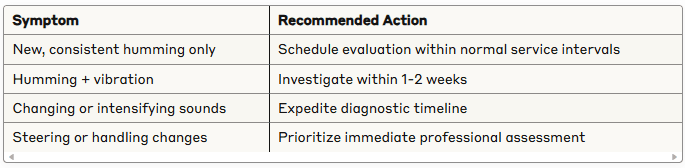
Experience demonstrates that most speed-related humming does not indicate immediate safety concerns. Modern automotive engineering incorporates substantial safety margins and progressive wear characteristics.
Recommended Action Timeline:
(Contact Westside Auto for professional auto assessment)
Is Speed-Related Humming Normal?
Every vehicle develops unique acoustic characteristics as components settle into operational patterns. Mechanical tolerances naturally adjust to real-world operating conditions, and new sounds may emerge as part of normal system evolution.
Reality Check:
- Vehicles with seemingly concerning acoustic signatures often provide years of additional reliable service
- Others with minimal symptoms may be approaching optimal service intervals
- Effective evaluation requires understanding individual vehicle history and operating conditions
Professional Maintenance Recommendations
Speed-synchronized humming often represents sophisticated engineering systems functioning as designed. Modern components incorporate:
- Predictable wear characteristics
- Progressive warning systems
- Extensive safety margins extending beyond initial acoustic indicators
Rather than indicating system failure, these sounds frequently represent advanced engineering communicating operational status through carefully designed feedback mechanisms.
Takeaways: Understanding Your Car's Humming Sounds
Recognizing and understanding speed-synchronized humming provides valuable insight into your vehicle's mechanical condition. This knowledge enables proactive maintenance decisions based on actual component status rather than uncertainty.
Remember:
- Most speed-related humming is not an emergency
- Modern vehicles are designed to communicate operational status
- Early detection allows for planned maintenance rather than unexpected repairs
- Professional diagnosis provides definitive answers and peace of mind
Modern vehicles are engineered for longevity and designed to communicate their operational status through multiple channels, including acoustic feedback. Speed-synchronized humming represents one aspect of this sophisticated communication system, providing early indication of service needs while maintaining safe, reliable operation.
Understanding your vehicle's acoustic communications enhances both ownership experience and maintenance decision-making. When in doubt, consult with automotive professional for accurate diagnosis and recommendations.